
Aug 26,2025
In today’s hyper-connected world, phone calls are as essential as the air we breathe—or at least close. Yet, for many businesses and individuals, traditional landline phones are beginning to feel like a relic of a bygone era. Enter VoIP, a technology that has quietly transformed the way we communicate. But if you’re not a tech wizard, the letters V-O-I-P might as well be an alien language. No worries—that’s exactly what we’re going to break down, in plain English. By the end of this post, you’ll understand what VoIP is, why it’s important, and how it can make your life easier, cheaper, and smarter.
1. VoIP in a Nutshell
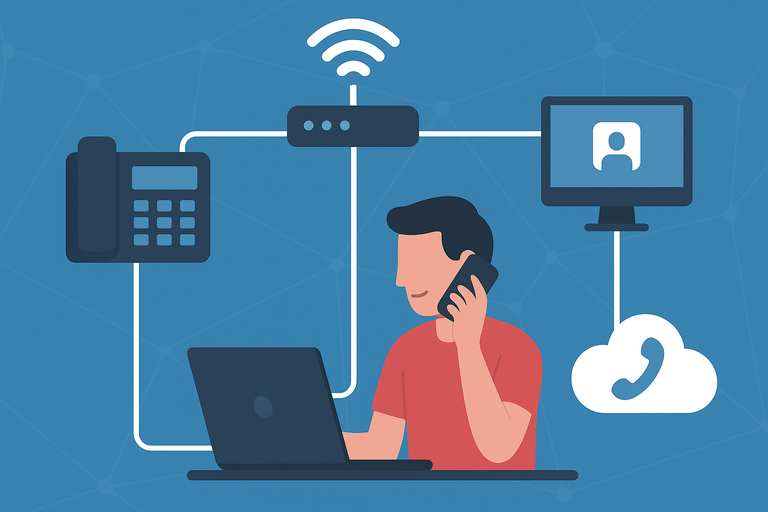
At its core, VoIP stands for Voice over Internet Protocol. That sounds complicated, but the concept is simple: instead of using traditional telephone lines to make calls, VoIP uses the internet to transmit your voice.
Imagine sending a text message. The words travel digitally through your phone or computer. VoIP works similarly, but instead of letters, it sends your voice in packets of data across the internet. These packets reassemble on the other end, and voilà—you hear the person you’re calling.
No heavy copper wires. No clunky switches. Just pure digital communication.
2. How VoIP Works (Without the Tech Jargon)
If you’re not tech-savvy, this part might seem intimidating. But let’s simplify it:
-
Your Voice Becomes Data – When you speak into a VoIP phone or an app, your voice is converted into digital signals, broken into tiny “packets.”
-
Packets Travel the Internet – These packets zip across the internet like super-fast digital letters.
-
The Other End Reassembles It – The recipient’s device puts the packets back together, turning them into sound you can understand.
Think of it like sending a video file to a friend. You don’t send a VHS tape through the mail anymore; you send digital data. VoIP is basically doing that with your voice.
3. VoIP vs. Traditional Phones
Traditional landline phones rely on PSTN (Public Switched Telephone Network) lines—physical cables that connect phones around the world. VoIP eliminates most of this infrastructure and instead relies on an internet connection.
Here’s why that matters:
| Feature | Landline | VoIP |
|---|---|---|
| Cost | Usually higher | Usually lower |
| Mobility | Tied to a location | Use anywhere with internet |
| Features | Limited | Advanced (call forwarding, voicemail-to-email, video calls) |
| Installation | Technicians, wiring | Simple, often plug-and-play |
In short: VoIP is cheaper, smarter, and more flexible.
4. Why VoIP Is the Future of Business Communication
If you run a business, switching to VoIP isn’t just a tech upgrade—it’s a strategic move. Here’s why:
-
Cost Savings – VoIP often reduces your phone bill by 30–70%. International calls? Way cheaper.
-
Remote Work Ready – Employees can use VoIP apps on their laptops, smartphones, or VoIP-enabled phones. Location doesn’t matter.
-
Advanced Features – From call forwarding and auto-attendants to video conferencing and CRM integration, VoIP does what traditional phones simply can’t.
-
Scalability – Adding a new line is as easy as adding a new user online, no need to install extra wiring.
Businesses that embrace VoIP are future-proofing their communication infrastructure while keeping costs low and operations flexible.
5. Common Misconceptions About VoIP
Even though VoIP has been around for decades, myths still linger. Let’s bust a few:
-
Myth 1: VoIP is unreliable
Truth: Modern VoIP is extremely stable. High-speed internet makes downtime rare, and many providers offer service-level agreements to ensure reliability. -
Myth 2: Calls sound robotic
Truth: Early VoIP had this problem. Today, HD voice codecs make calls crisp and clear. Most people can’t tell the difference from a landline. -
Myth 3: It’s only for tech companies
Truth: Businesses of all sizes—from retail stores to law firms—use VoIP. If you have a business phone system, VoIP can upgrade it.
6. Types of VoIP Services
Not all VoIP is created equal. Here are the most common options:
-
Computer-to-Computer VoIP – Think Skype or Zoom. Both parties need the app installed.
-
Computer-to-Phone VoIP – You call a landline from your computer. A small fee usually applies.
-
Phone-to-Phone VoIP – Uses a VoIP provider and works with regular phones or VoIP-enabled phones.
-
Hosted PBX (Private Branch Exchange) – A cloud-based phone system for businesses with multiple users and advanced features.
For most businesses, a hosted VoIP solution offers the perfect combination of cost savings, features, and scalability.
7. What You Need to Use VoIP
Getting started with VoIP isn’t rocket science. Here’s what you typically need:
-
A Stable Internet Connection – Preferably broadband. More speed = better call quality.
-
VoIP-Compatible Device – This can be a computer, smartphone, or dedicated VoIP phone.
-
VoIP Service Provider – Companies like PCS VoIP provide the service, features, and support.
-
Optional Accessories – Headsets, conference phones, or adapters for older phones.
Once you have these, setting up VoIP is usually a matter of plug-and-play or simple app installation.
8. Benefits of VoIP for Everyday Life
While businesses are the primary beneficiaries, VoIP also improves personal communication:
-
Lower Costs – Save on international calls to family and friends.
-
Video Calls and Conferencing – Connect face-to-face without traveling.
-
Portability – Use your phone number anywhere with an internet connection.
-
Integration with Apps – From messaging apps to calendars, VoIP can streamline your digital life.
VoIP isn’t just for work—it’s a smarter, more versatile way to communicate.
9. Potential Drawbacks and How to Avoid Them
No technology is perfect. VoIP has a few limitations:
-
Internet Dependency – No internet, no call. Solution: Keep a backup connection or a traditional line.
-
Power Outages – Unlike landlines, VoIP stops working if your internet and power are down. Backup power solutions help.
-
Security Concerns – Like all internet traffic, VoIP can be hacked. Use a reputable provider with encryption.
The good news? Modern providers address all of these issues, making VoIP safe and reliable.
10. Making the Switch to VoIP
If you’re ready to take the leap, here’s a simple roadmap:
-
Evaluate Your Needs – How many users, features, and devices?
-
Choose a Provider – Look for reliability, support, and pricing transparency.
-
Test Your Internet – Ensure your bandwidth can handle calls without lag.
-
Migrate Gradually – Keep your old line for a short overlap period.
-
Train Your Team – Even basic VoIP apps require a little guidance.
PCS VoIP, for instance, provides a smooth migration with local support, ensuring you never feel left in the dark.
11. VoIP Jargon, Explained Simply
Sometimes the terminology scares people off. Here’s a quick translation:
-
Codec – The method VoIP uses to compress and send your voice. Think of it like zipping files.
-
SIP (Session Initiation Protocol) – The language VoIP devices use to talk to each other.
-
PBX – A business phone system. “Private Branch Exchange” sounds fancy, but it just means a system that handles multiple internal lines.
-
Hosted/Cloud PBX – Your PBX lives on the internet, not in your office.
No need to memorize this—just knowing the gist helps you sound confident in meetings.
12. VoIP Trends in 2025 and Beyond
VoIP is evolving faster than ever. Here’s what’s on the horizon:
-
AI-Powered Call Management – Automated call transcription, smart routing, and voice analysis.
-
Deeper Integration – VoIP will integrate more tightly with CRM, team collaboration apps, and IoT devices.
-
5G VoIP – Faster, more reliable mobile VoIP calls.
-
Global Accessibility – VoIP is lowering communication barriers in developing markets.
The future is digital, mobile, and connected—and VoIP is leading the charge.
13. Conclusion: Why VoIP Matters
In a nutshell, VoIP isn’t just a tech trend—it’s a revolution in how we communicate. It’s cheaper, smarter, and more flexible than traditional phone lines. For businesses, it’s a competitive advantage. For individuals, it’s convenience and cost savings.
If you’re still using an old landline, now’s the time to consider a smarter, future-proof solution. PCS VoIP makes the transition simple, reliable, and surprisingly affordable—without leaving you in a maze of jargon.
The moral: Don’t let outdated technology hold you back. VoIP is the bridge to a modern, connected future—one call at a time.