
19 Jan , 2026
It usually starts as a small inconvenience.
A customer tries calling just before lunch. The phone rings, then rings again. No answer. They hang up, assuming everyone is busy, and make a mental note to try again later.
They don’t.
That missed call never shows up in a report. No alert goes off. No one knows it happened. But that moment—quiet and invisible—is often where phone downtime does the most damage.
Phones Are Trusted Until They Fail
Most businesses don’t think about their phone systems very often. Phones are expected to work the way lights turn on or doors unlock. They’re infrastructure, not strategy.
As long as calls are coming through, there’s little reason to question:
-
Whether calls are routing correctly
-
Whether voicemails are actually being delivered
-
Whether failover systems would activate during an outage
-
Whether anyone would even know there was a problem
The danger lies in that assumption. Phone systems tend to fail quietly before they fail loudly.
Downtime Rarely Announces Itself
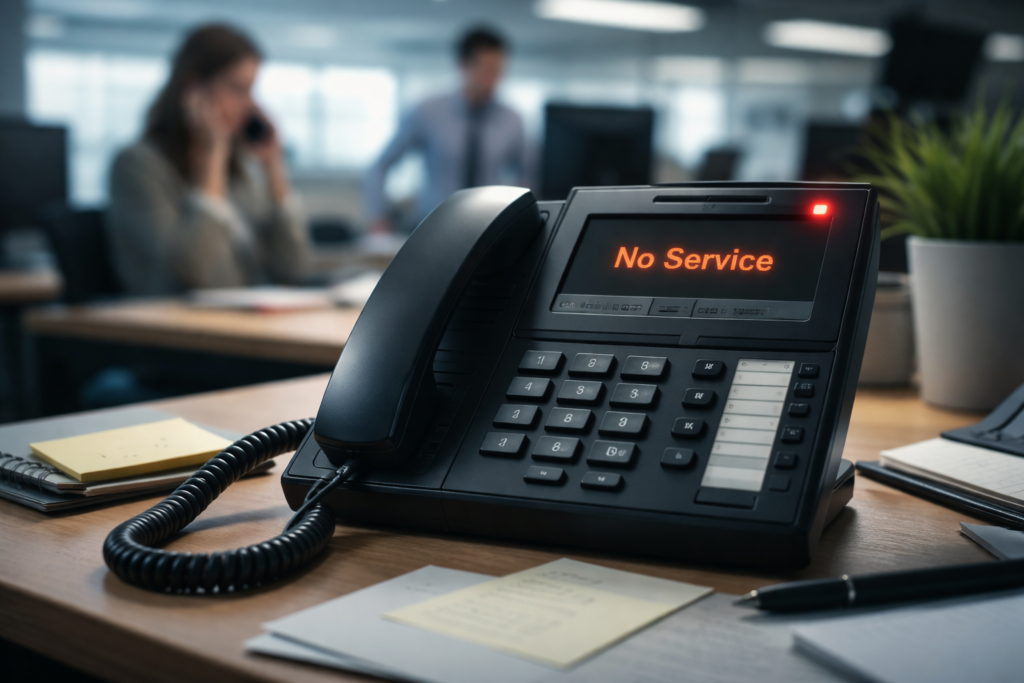
When businesses imagine phone downtime, they picture a total outage—no dial tone, phones completely dead, everyone aware something is wrong.
But real downtime looks different.
It looks like:
-
Calls going straight to voicemail without explanation
-
Call quality degrading until conversations are impossible
-
A front desk that can call out but not receive calls
-
A location that’s unreachable while others work fine
These issues can last minutes, hours, or days before someone pieces together what’s happening. By then, the damage is already done.
The Calls You Never Hear About
Every business has calls that matter more than others.
A new lead ready to buy
A long-time client with an urgent issue
A vendor trying to confirm a delivery
A candidate calling about an interview
When these calls don’t connect, the caller rarely sends an email explaining why. They assume the business wasn’t available.
And from their perspective, that assumption is correct.
Most callers won’t keep trying. They won’t leave a voicemail if the experience already feels broken. They simply move on—to a competitor, to another solution, to someone who answered.
Revenue Doesn’t Always Disappear Dramatically
Phone downtime doesn’t always cause an obvious drop in sales. That’s part of why it’s underestimated.
Instead, revenue erodes slowly:
-
Deals take longer to close
-
Customer churn increases
-
Support issues escalate
-
Repeat calls increase staff workload
-
Online reviews mention “couldn’t reach anyone”
By the time leadership notices something feels “off,” the cause isn’t obvious. Phone reliability rarely gets the blame first.
Customer Trust Has a Short Memory
Customers don’t think about your internal systems. They only experience the outcome.
If they can’t reach you when they need to:
-
Confidence drops
-
Frustration rises
-
Loyalty weakens
One bad experience might be forgiven. Two create doubt. Three form a habit of calling somewhere else first.
In industries where response time matters—healthcare, legal, real estate, service businesses—being unreachable isn’t just inconvenient. It’s unacceptable.
Internal Teams Carry the Hidden Cost
When phones fail, employees feel it immediately.
Front-line staff deal with confused or frustrated callers once systems return. Sales teams discover leads went cold. Managers field questions they can’t answer because they didn’t know there was a problem in the first place.
Teams start compensating manually:
-
Checking missed call logs
-
Asking customers to repeat themselves
-
Using personal phones as backups
-
Apologizing for issues they didn’t cause
Over time, this creates burnout, inefficiency, and frustration—especially when downtime becomes “one of those things that just happens.”
Why Businesses Keep Underestimating the Risk
There are common patterns behind this blind spot:
-
“It hasn’t happened recently.” Reliability feels permanent until it isn’t.
-
“It was only a few minutes.” Enough time for critical calls to fail.
-
“We have voicemail.” Which many customers won’t trust or use.
-
“Our provider will tell us if something’s wrong.” Often, they don’t.
Without visibility, downtime feels hypothetical. And hypothetical risks rarely get prioritized.
Preparedness Isn’t About Fear—It’s About Control
Businesses that take phone uptime seriously aren’t pessimistic. They’re realistic.
They plan for:
-
Redundancy instead of single points of failure
-
Monitoring instead of assumptions
-
Clear escalation paths instead of guesswork
-
Accountability instead of blame
They know that when communication fails, every other part of the business feels it.
The Most Expensive Downtime Is Invisible
The true cost of phone downtime isn’t measured in minutes offline.
It’s measured in:
-
Conversations that never happened
-
Relationships that quietly cooled
-
Opportunities that found someone else
-
Trust that didn’t come back
Phones don’t just connect calls. They connect people at moments that matter.
When that connection breaks—even briefly—the impact lasts far longer than the outage itself.